
From its 2016 launch to now, Niantic’s AR mobile game has turned into a stable, high-earning giant with a global player base that keeps coming back.
If you check the 2025 Performance Dashboard, the numbers tell the story.
The Monthly Active Users sit at a solid 70–80 million baseline, spiking to 122–127 million during big events like Community Day or Pokémon GO Fest.
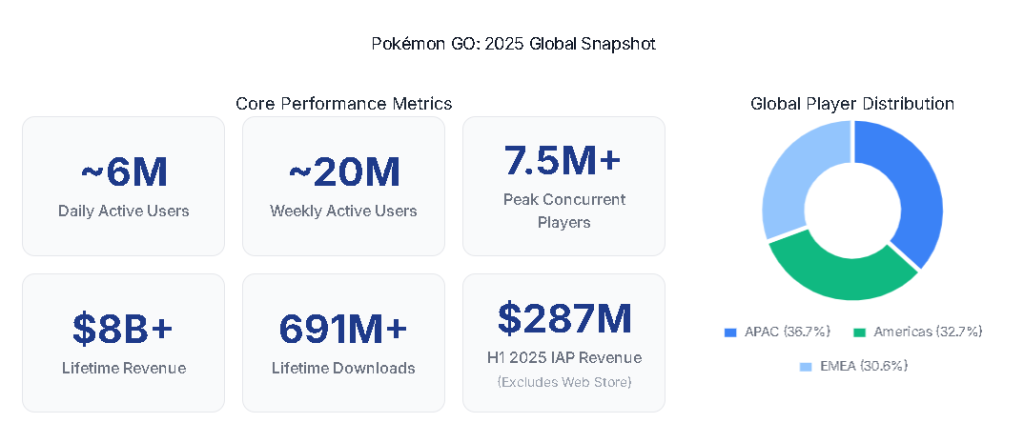
The Daily Active Users hold steady at 5.4–6.0 million, showing insane day-to-day loyalty.
And even with spending shifting to the Niantic Web Store, the game still pulled in $287 million in H1 2025, ranking 11th highest-grossing worldwide.
That’s the power of a game that blends location-based play, in-app purchases, and a finely tuned Live Ops schedule.

How Many People Play Pokémon GO in 2025?
When you check the numbers, Pokémon GO in 2025 has a baseline of about 70–80 million Monthly Active Users (MAU).
That’s the stable crowd playing every month.
During huge events like GO Fest or Community Day, that number can double, peaking at 122–127 million.
The Daily Active Users (DAU) sit at 5.4–6.0 million, which means millions log in every single day without fail.
Zoom out to a Weekly Active Users (WAU) view, and you get around 20 million, with half of them (yes, about 50%) playing daily.
That’s what game analysts call exceptional player engagement stickiness, and very few mobile games get anywhere near it.
Pokémon GO Revenue and Monetization in 2025
When you look at the numbers, Pokémon GO pulled in about $287M from In-App Purchases (IAP) in H1 2025, placing it as the 11th highest-grossing mobile game worldwide.
That’s a stable, resilient position, especially when you realize these figures don’t even show the full picture, because a lot of spending now happens outside the App Store and Google Play.
Here’s the snapshot:

A big part of this “hidden revenue” comes from the Niantic Web Store, where you can buy PokéCoins, Remote Raid Passes, and Event Tickets directly.
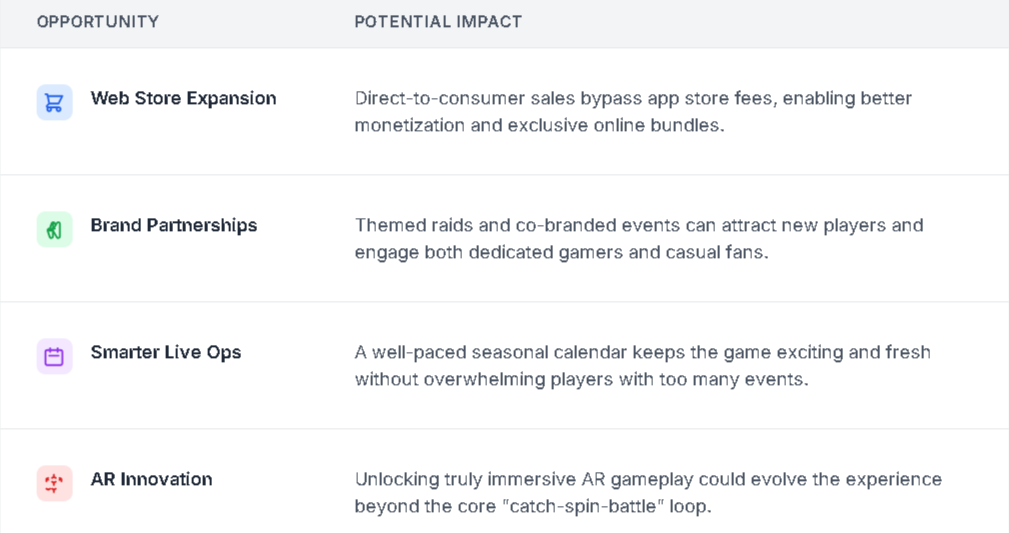
This bypasses app store commissions, giving Niantic higher profit margins and letting them offer exclusive bundles you can’t find in-app.
So the real gross revenue is higher than what the IAP charts show.
If you follow the spending trends by platform, Android players make up the majority of the user base, but iOS players spend much more per person, about 3.5× more.
That’s why Niantic’s monetization strategy maintains a strong focus on premium offers and event bundles that appeal to high-value iOS users, while still sustaining volume sales from the massive Android audience.
Player Demographics and Behavior
When you look at Pokémon GO Player Demographics in 2025, you see a clear dual-cohort pattern.
- The Age Cohort 21–30, split into 32.5% (ages 21–25) and 25.4% (ages 26–30), drives most of the activity and social play.
- The Age Cohort 35–54, making up 49% of active players, delivers the highest spending power, boosted by strong Nostalgia for the franchise and higher Disposable Income.

You’ll notice the game’s Player Motivations still lean on its core loop — 85% focus on Catching Pokémon, 45% join Gym Battles, 35% take part in Raid Battles, 25% trade, and 20% play PvP.
That mix shows why the collection mechanic keeps the game alive while competitive and social features keep the most engaged players hooked.
Events and Live Ops: The Engine Behind Engagement
If you’ve played long enough, you know Pokémon GO Live Ops is the pulse that keeps the game alive.
GO Fest draws the highest annual concurrent player count, with legendary releases and global challenges that push even lapsed players back into action.
Community Day pulls in 25M+ participants every month, giving you a reason to hunt a shiny, stockpile candy, or just hang out with friends.
The Pokémon GO Tour adds thematic depth with regional exclusives, while Safari Zone gives ticketed, location-based bonuses for players who love the thrill of traveling for a catch.
The pattern is clear: an event-driven engagement surge happens every time.
Regional Insights
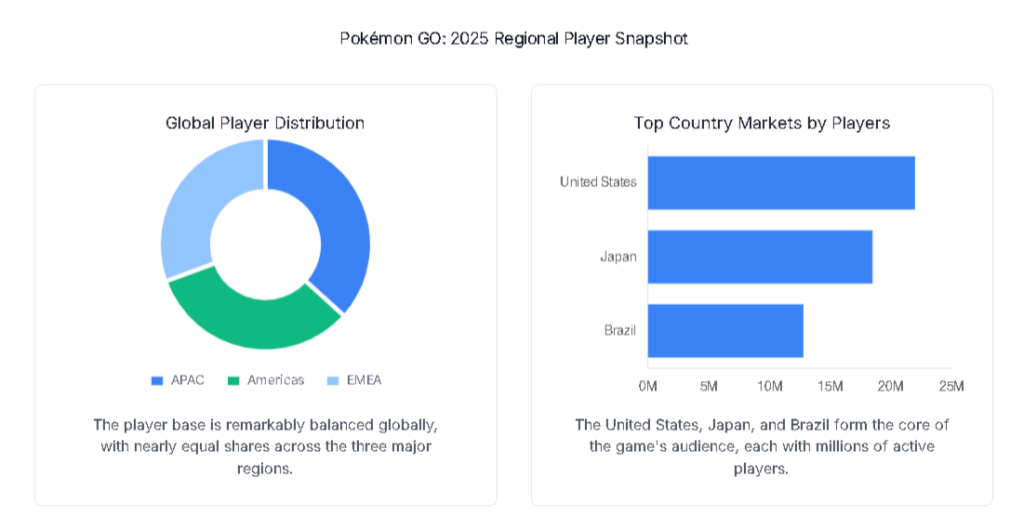
In the global market share, APAC stands at 36.7% of the Player Volume Share, giving it clear regional dominance.
The Americas follow with 32.7%, while EMEA holds 30.6%.
You can see that the gap between these regions is tight, which means Niantic can’t rely on one market alone; each has to stay active to keep numbers strong.
Outlook for 2026 (Based On Experts’ Analysis)
If you’re still playing in July 2026, you’ll be in the middle of Pokémon GO’s 10th Anniversary — and that’s when the real magic happens.
A Nostalgia Surge will pull back old friends you haven’t seen on your friends list for years, just like it did during past milestone events.
You’ll see more shinies, legacy Pokémon, and early-game features returning as part of the reactivation push.
Opportunities to Watch:
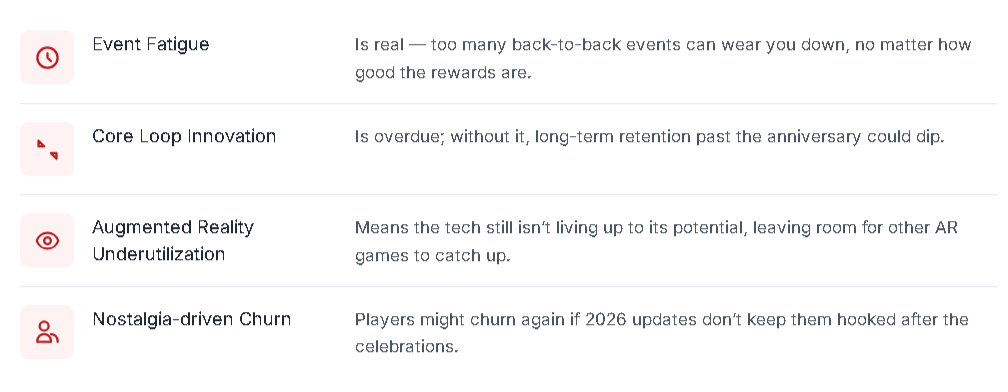
Challenges on the Horizon:
Historical Timeline of Pokémon GO Player & Revenue Milestones
Niantic turned Augmented Reality Gaming into a global craze, breaking download records and reaching Revenue Milestones in just months.
From there, each year tells its own story: of peak player waves, sustained engagement, and monetization cycles tied to Global Markets and big in-game events.
*2025 revenue based on first-half run rate projections.
You can track trends here and see how big feature drops line up with revenue lifts.
When you compare growth across years, anniversary spikes and major events always align with the highest player counts.
If you identify patterns, you’ll see a rhythm: launch → new feature → engagement surge → monetization spike.
That historical rhythm is why Niantic remains one of the most profitable names in AR mobile gaming nearly a decade later.